
Materials & choices
Indian sandstone or porcelain: which is better for your patio?
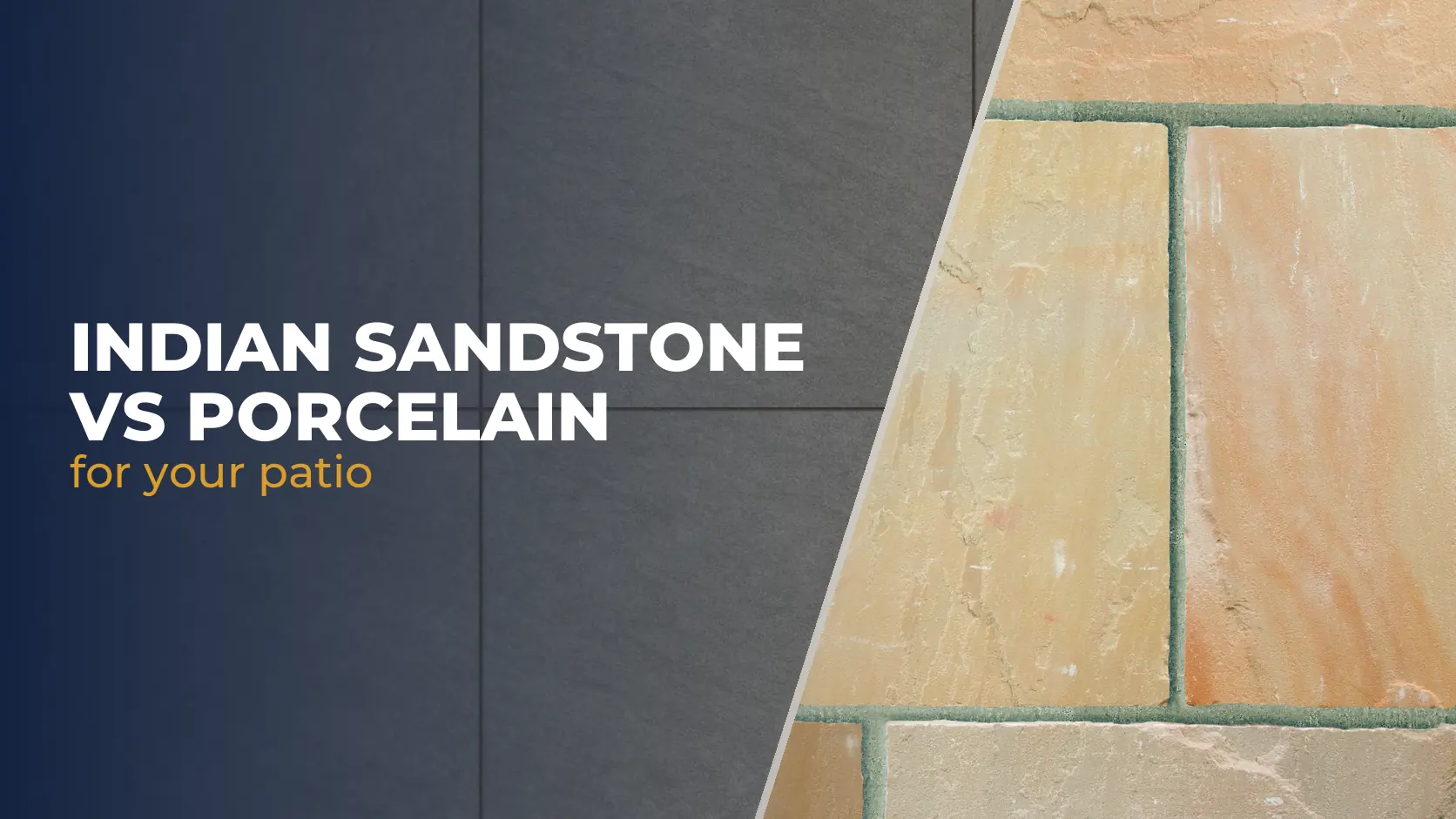
The short answer first. If you want a patio that looks natural, costs less and does not mind showing its age, Indian sandstone. If you want one that stays the colour it was on the day it went down, shrugs off spills and needs little more than a brush and a bucket, porcelain.
We lay both, and neither one is simply an upgrade on the other. The rest of this is about when each one earns its place, and about the part of any patio that matters more than the slabs.
What each one costs
On a typical patio, porcelain comes out at around 13 per cent more than Indian sandstone on our own rates. On a small patio the gap is wider:
| The job | Indian sandstone | Porcelain |
|---|---|---|
| Small patio, onto grass (10 to 15 m²) | £1,700 to £2,300 | £2,250 to £2,800 |
| Medium patio, onto grass (20 to 30 m²) | £3,100 to £4,550 | £3,500 to £5,150 |
| Replacing old slabs (20 to 30 m²) | £3,600 to £5,250 | £4,000 to £5,900 |
Both columns are for a standard range of each. A premium range of either adds about a third or more on top.
Why is the gap wider on a small patio? Materials come by the pallet, and a small patio still pays for a whole one. The minimum is bigger for porcelain, so on a 10 square metre patio it works out about a third dearer than stone, against around 13 per cent on a patio twice that size.
These figures assume the patio goes onto fairly level ground with nothing unusual underneath. Steps, walls and big changes in level are extra. They are ranges, not quotes.
Indian sandstone: what you get, and what to watch
Indian sandstone is quarried, split and cut, so no two slabs are quite the same. That is most of its appeal: warm, mixed colours, a riven surface with natural grip underfoot, and a look that sits comfortably next to older brick and stone.
It is also porous, and in a British garden that has consequences.
It weathers. The colours soften over the years, and the stone picks up the marks of use. Some people like that. It is part of why natural stone looks at home.
Black spot. In shade and damp, a lichen can take hold on sandstone and leave small black spots that do not wash off, because it roots into the surface. It needs a cleaner made for natural stone, not a stronger jet wash.
Go easy with the jet wash. A high-pressure washer held close can wear away the face of the stone and blow out the pointing between the slabs.
Stains soak in. Red wine, barbecue fat and rust from metal furniture can all leave marks. A sealer applied after laying makes stone easier to keep clean, but it has to be a breathable one: a sealer that traps moisture in the stone can make the surface flake in a frost.
Calibrated or hand-cut? Calibrated stone is cut to an even thickness, which makes it quicker to lay level. Hand-cut stone varies in thickness from slab to slab, so each one has to be bedded individually, and that shows in the labour. Either can make a good patio, but it is worth knowing which one a quote is for.
Porcelain: what you get, and what to watch
Porcelain paving is made in a factory, fired at a very high temperature, and comes out almost completely non-porous: it absorbs less than half a per cent of its weight in water. That one fact is behind nearly everything good about it.
It barely stains. Wine, oil and barbecue fat sit on the surface and clean off.
It keeps its colour. What you choose is what you keep.
Frost does not get into it, because there is almost no water inside to freeze.
It is easy to keep clean. Moss and algae can still grow on it in a shady corner, but they have nothing to root into, so they come off with a brush and soapy water.
Outdoor porcelain has a textured, anti-slip finish. Ask for the slip rating: R11 is the usual one for outside. Smooth indoor-style porcelain has no place on a patio.
And its weaknesses, which are just as real:
It has to be laid properly, or it lets go. Because nothing soaks into porcelain, ordinary mortar has nothing to grip. It needs a primer on the back of every slab and a full bed of mortar underneath. Laid on a few dabs of mortar, as cheap patios sometimes are, porcelain slabs come loose and rock.
It is harder to cut. Porcelain needs diamond blades and more time at every cut, which is part of why it costs more to lay.
A chipped edge shows. Porcelain is hard, but a heavy knock on an edge can chip it, and the colour underneath does not always match the face.
The part that matters more than the slabs
Both materials fail in the same way when the groundwork is skimped. When a patio goes wrong, it is rarely the slabs' fault.
A patio needs a compacted sub-base of crushed stone, around 100 mm deep for a patio you walk on, a full bed of mortar under every slab, and a fall, so that rainwater runs away from the house rather than towards it.
There is a simple test. A slab laid on a full bed sounds solid when you tap it. One laid on dabs sounds hollow, and it is the hollow ones that crack, rock or come loose.
It is the same point we make about driveways in block paving or tarmac: the part you never see decides how long the part you do see lasts.
Keep a few spare slabs
Whichever you choose, ask for a few spare slabs from the same batch. Natural stone varies from one delivery to the next, and porcelain ranges get discontinued. If a slab ever cracks, a spare from the original batch is the difference between a repair nobody notices and one that stands out for years.
When Indian sandstone is the better choice
We would point you towards Indian sandstone when:
- The budget matters most. It is the cheaper of the two, especially on a small patio.
- The house or the garden is traditional. Older brick, stone walls and cottage planting suit a natural stone.
- You like the idea of it ageing. Sandstone mellows over the years; porcelain stays exactly as it was.
- You want natural grip without a factory finish.
When porcelain is worth the extra
Porcelain earns its price when:
- The garden is shady or damp. There is nothing for black spot to root into.
- The patio is outside the kitchen or next to the barbecue, where things get spilt.
- You want a clean, modern look, with large slabs and narrow joints.
- You would rather spend the weekend on the patio than cleaning it.
A short checklist, whichever you choose
Before you accept a quote, make sure it answers these:
- Is every slab on a full bed of mortar, and is the porcelain primed on the back?
- How deep is the sub-base?
- Which way does the patio fall, and where does the rainwater go?
- For stone, calibrated or hand-cut? For porcelain, what is the slip rating?
- Will there be spare slabs from the same batch?
Getting a number for your own patio
The estimate tool on this site works for both materials. It takes about a minute to fill in, the guide price arrives by email, and it runs on the same rates as the figures above. For a fixed price, we come and look: the site visit is free, and there is no obligation to go ahead. You can see everything else we do on our services page.
We lay patios across Barnsley and up to 30 miles around it. If you cannot decide between the two, ask us on the visit. We bring the catalogue with the full range of both, and go through it with you in daylight, in your own garden.