
Materials & choices
Block paving or tarmac: which is better for your driveway?
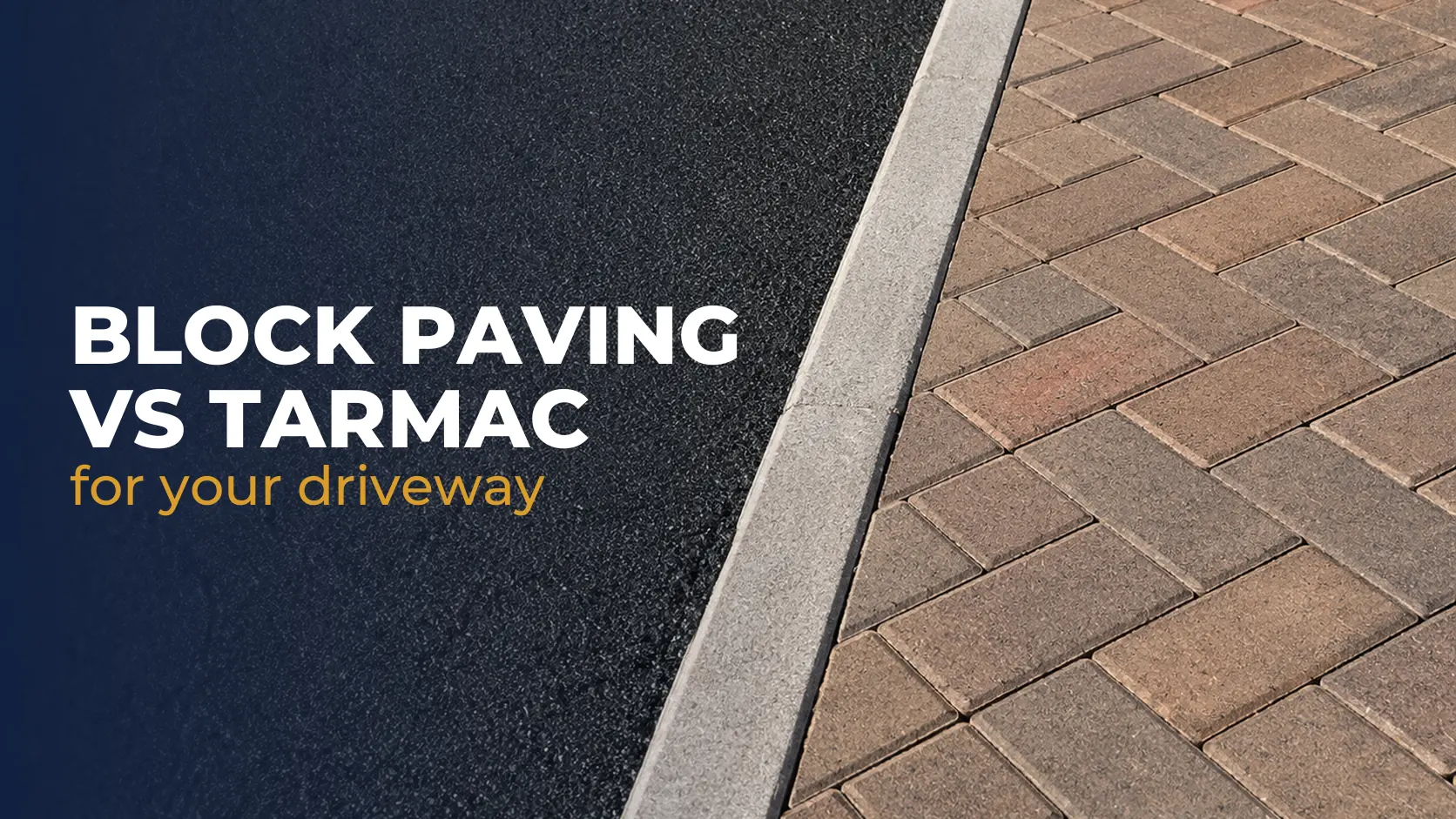
The short answer first, because it is simpler than most people expect. If you want the cheapest drive that is still laid properly, tarmac. If you want a drive with a border or a pattern, one that matches the rest of the front of the house, and one you can repair a patch of without it showing, block paving.
We lay both. The rest of this is about when that answer flips, and about the one part of any drive that matters more than which surface goes on top.
What each one costs
On our own rates, tarmac comes out at roughly 60 per cent of the price of a standard block paving drive of the same size. That ratio barely moves, whether the drive is a small single or a large double:
| The job | Tarmac | Block paving |
|---|---|---|
| Single drive, onto grass (25 to 30 m²) | £2,150 to £2,500 | £3,650 to £4,300 |
| Double drive, onto grass (45 to 60 m²) | £3,600 to £4,700 | £6,050 to £7,750 |
| Double drive, replacing old tarmac (45 to 60 m²) | £4,200 to £5,450 | £7,200 to £9,250 |
The block paving column is a standard block. A premium or tumbled block adds more again: on a 50 square metre drive, the gap between tarmac and a premium block is over £5,000. What moves a block paving price, line by line, is in our article on what a block paving driveway costs in Barnsley.
All of these assume a machine can reach the drive and nothing unusual turns up under the old surface. They are ranges, not quotes.
So tarmac is the cheaper answer, clearly. The real question is what you give up for the difference.
What goes wrong with tarmac
Tarmac is stone held together with bitumen, and bitumen is an oil product. That one fact explains most of its weaknesses.
Fuel dissolves it. Petrol and diesel do not just stain tarmac, they soften the binder, and the stones underneath start to come loose. A small spill mopped up straight away is fine. Engine oil works more slowly, but a car that drips in the same spot for a year leaves a soft patch.
It softens in the heat, especially in its first summer. New tarmac takes time to harden. On a hot day, a motorbike stand, a caravan jockey wheel or a car's wheels turned on the spot can press marks into it that do not come out.
Edges fray without a restraint. An unsupported tarmac edge crumbles slowly from the side. A properly laid tarmac drive has a kerb or a row of blocks holding its edge, like the one in the photo above.
Patches show. If a section has to come up, for a burst pipe, a new cable or a sunken area, the repair is a new piece of tarmac next to an old one, and it stays a different shade for years.
None of that makes tarmac a bad surface. It makes it a surface that suits some drives better than others.
What goes wrong with block paving
Block paving has its own list, and it is only fair to put it next to the other one.
Weeds and moss in the joints. The sand between the blocks is where they grow, especially on shaded drives and along the edges. It is maintenance rather than failure: brushing sand back into the joints and a weed treatment once or twice a year. But it is maintenance tarmac does not need.
Dips and ruts where the base was skimped. When a block drive sinks where the car sits, the blocks are rarely the problem. The layer underneath was not deep enough, or not compacted properly.
It still stains. Oil does not break concrete blocks down the way it breaks tarmac down, but it does leave a mark that takes work to lift.
Colours soften over time. Concrete blocks weather, like most things that live outdoors. Some ranges hold their colour better than others, which is worth asking about when you choose.
The part that matters more than the surface
When a drive fails, it rarely fails at the surface. It fails underneath.
Tarmac and block paving both sit on a sub-base of crushed stone, and how deep it needs to be depends on what will drive over it. The paving manufacturers' own guidance puts it at around 150 mm for cars, deeper on clay or soft ground, and deeper again for vans or a motorhome. A drive laid on half that looks exactly the same on the day it is finished. The difference arrives in the third winter, as ruts in block paving or cracks in tarmac.
That is why the most useful question to ask anyone who quotes you, for either surface, is how deep the sub-base will be, and what is going into it. A confident, specific answer is worth more than a lower price.
Repairs, and the day a pipe needs to come up
This is block paving's real advantage, and it is a practical one rather than a cosmetic one.
If a section of block paving sinks, or a utility company has to dig down to a pipe under your drive, the blocks can be lifted, the base put right underneath, and the same blocks relaid. Done carefully, you cannot tell where it happened.
With tarmac, the same job leaves a patch. It is sound, but you can see it.
If your drive sits over a water main, a gas supply or old drains, that difference is worth weighing up.
Rainwater, and the planning rule for front drives
If the drive is in your front garden and more than five square metres, the rainwater has to soak away within your own property, either through the surface itself or into a lawn, a border or a soakaway. If it runs off onto the road, the drive needs planning permission.
Both surfaces can meet that rule when the water is directed into the garden. If you want the surface itself to let the water through, permeable block paving is the usual answer. Porous asphalt, a kind of tarmac that lets water through, exists too, but the government's own guidance on paving front gardens says it should be laid by a specialist company.
There is more on this, including the separate licence you need for a dropped kerb, in our article on whether you need planning permission for a driveway.
When tarmac is the better choice
We would point you towards tarmac when:
- The budget decides it. A well-laid tarmac drive is a better drive than a cheaply laid block one.
- It is a big, plain area, such as a long access drive, a large parking area or a yard. Tarmac covers big areas quickly and without joints.
- Nobody really looks at it. A side or rear parking space does not need a pattern.
- You want it done quickly. Tarmac goes down faster than blocks, so the drive is out of use for fewer days. There is more on how long a new driveway takes.
When block paving is worth the extra
Block paving earns its price when:
- The drive is the front of the house. Borders, patterns and colour are where it pulls ahead, and it can match a patio, steps or a path.
- You want detail. A contrasting border, a pattern, a step or a change of level built in. Tarmac can follow a curve, but it cannot do detail.
- You want a repair to be invisible, as above.
- Part of it will sit under a car that drips. Oil marks a block, but it does not break it up.
- You want the surface itself to drain in a front garden.
A short checklist, whichever you choose
Before you accept a quote for either surface, make sure it answers these:
- How deep is the sub-base, and what is in it?
- What holds the edges? Tarmac needs a kerb or a row of blocks. Block paving needs edge restraints set in concrete.
- Where does the rainwater go?
- Is taking the old surface away included?
Getting a number for your own drive
The estimate tool on this site works for both surfaces. It takes about a minute to fill in, the guide price arrives by email, and it runs on the same rates as the figures above. For a fixed price, we come and look: the site visit is free, and there is no obligation to go ahead.
We lay both surfaces across Barnsley and up to 30 miles around it. If you are torn between the two, ask us on the visit. We would genuinely rather you had the right drive than the dearer one.