
Materials & choices
How long does a new driveway take to install?
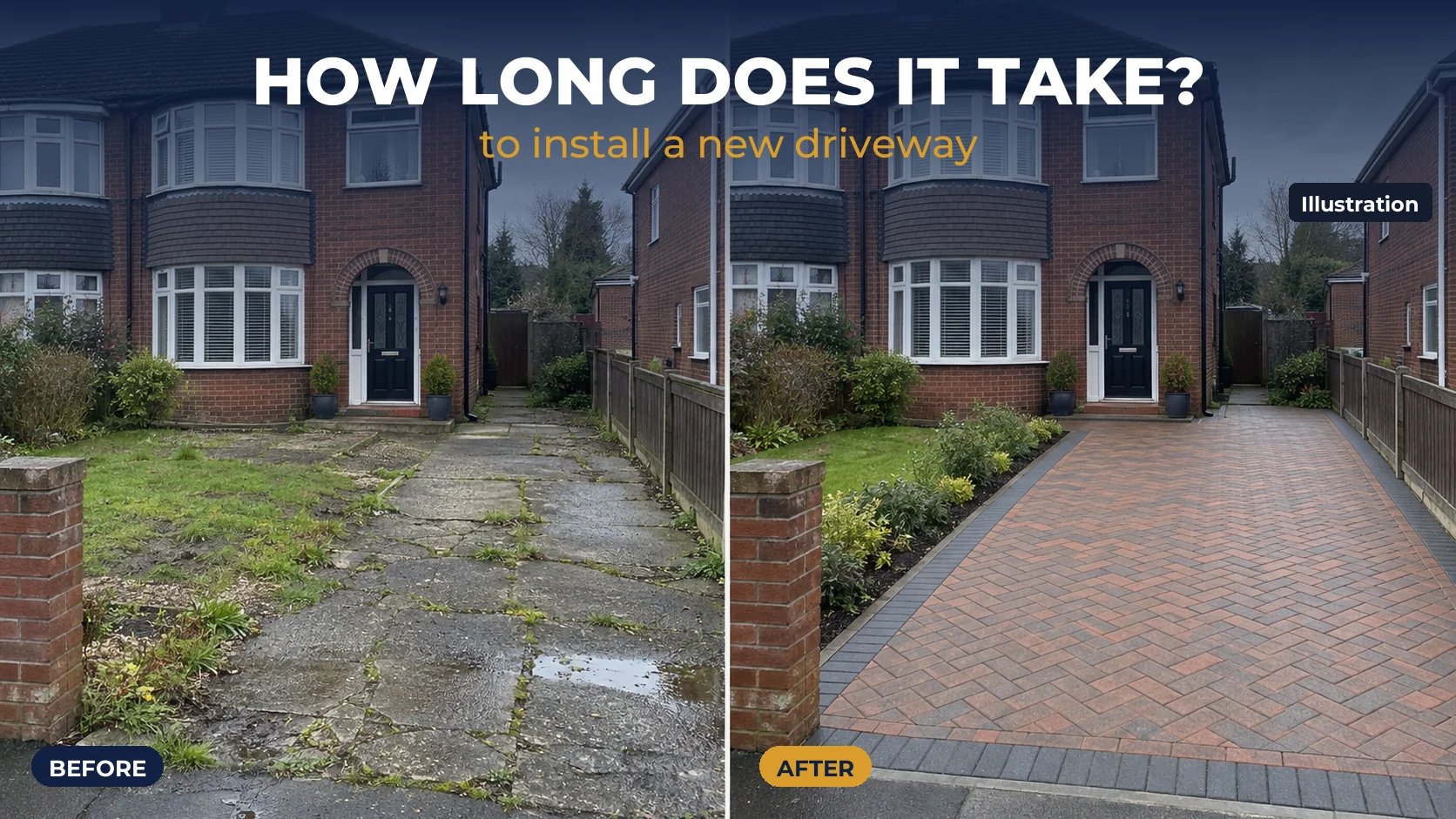
The short answer first. A typical block paving driveway takes around three to five working days on site, so up to a working week. A small one can be done in two or three days. A large one can take a full working week, and one with steps, walls, new drainage or no room for a digger can run to more than that.
Those are the days on site. Before the first one there may be a wait for a start date or a council licence. After the last one there is no wait at all: block paving can be driven on as soon as we tell you it is finished.
The rest of this is about where those days go, what stretches them, and what keeps a drive at the short end.
Where the days go
On a typical drive of around 40 square metres, the work takes three or four days, depending mostly on how easily a small digger can get in. Over four days, it usually goes like this:
| Day | What happens |
|---|---|
| 1 | The old surface comes up, the ground is dug out and the soil is taken away |
| 2 | The edges are set in concrete, and the sub-base goes in and is compacted |
| 3 | The sand is laid and screeded level, and the blocks go down |
| 4 | Cutting in at the edges, sand brushed into the joints, final compaction and a clean-up |
About half of that time goes into the part you will never see. For a drive you park on, the ground usually comes out to around 200 to 250 mm below the finished surface, and deeper on clay or soft ground: about 50 mm of block, a bed of sand, and a sub-base of crushed stone, which Marshalls, one of the largest paving manufacturers, puts at a minimum of 150 mm for most home driveways, and more on soft ground. On a 40 square metre drive, that dig produces something like 15 tonnes of soil, close to a full load for a grab lorry.
The sub-base goes in layers, each one compacted before the next goes on. It is the part that takes the most care to do properly and the easiest part to skimp on, and it decides whether the drive is still flat in ten years.
What adds days
- No room for a digger. If a machine cannot get in, the ground is dug by hand and barrowed out. It is the same amount of soil, moved much more slowly.
- Old concrete or tarmac. Grass or bare earth comes out quickly. Old concrete or tarmac has to be broken up first, and it is heavier to take away.
- Drainage. Since October 2008, a front drive over five square metres, new or replaced, has to be permeable or drain into a lawn, a border or a soakaway on your own property. Otherwise it needs planning permission. A channel drain and a soakaway take time to build, and on some drives they are what keeps the job clear of planning permission. There is more on that in our article on whether you need planning permission for a driveway.
- Steps, walls and changes of level. Anything built, rather than laid, takes longer, and some of it needs concrete to set before the next stage can go on top.
- The weather. Damp weather does not stop most of the work, although the joints are only sanded when the blocks are dry. Heavy rain does stop it, because a sand bed that gets saturated moves under the blocks and has to dry out or be replaced. So does frost: we do not lay on frozen ground or in a hard frost, and if the weather turns, we move the day rather than push on.
When can you drive on new block paving?
As soon as we tell you it is finished. Block paving has no curing time, unlike poured concrete and some other surfaces: once the blocks are down, the joints are filled and the last compaction is done, it is ready for the car.
What you cannot do is use it in the middle of the job. From the day the old surface comes up until the final compaction, the car needs to live somewhere else.
Is tarmac quicker than block paving?
A little. Tarmac goes down faster than block paving once the base is in, but new tarmac needs a day or two before it takes a car, so the drive is back in use only a little sooner. We compare the two properly in block paving or tarmac.
Between tarmac and standard block paving, the groundwork does not change: the dig and the sub-base take the same time, because they are doing the same job. A permeable drive is the exception. Its sub-base is built to hold water, and it is a different build.
What to sort out before the first day
The days on site are often the shortest part of the wait. Two things are worth starting early:
- A dropped kerb, if you need one. It needs its own licence from the council, separate from planning permission, and the kerb itself is built by the council or by a contractor licensed to work on the highway, not as part of the drive. If you are in Barnsley, the council says it will first come back to you within 28 days, so the application wants to go in before the drive is booked, not after it is laid. Other councils around us have their own timescales.
- Planning permission, if your drive needs it. Most do not. The usual reasons are the drainage above, or a dropped kerb onto a classified road, where Barnsley Council wants the planning permission in place before it takes the kerb application. It is worth knowing before you choose a surface, because the answer can change which one makes sense.
While we are there
A few things on your side keep the days running smoothly:
- Park the car somewhere else for the whole job, and tell anyone who is visiting.
- Let the neighbours know. A grab lorry and a delivery of blocks will be in the road for part of the time.
- Clear the area of pots, bins and anything else that would have to be moved round.
- Keep children and pets away from the digger and the saw.
- Tell us what is under the drive, if you know or suspect it: drains, water pipes, cables, an old soakaway. Something nobody knew about is one of the things that can move the finish date.
- If the drive is shared, or we need to cross a neighbour's land or a private road, the permission for it needs to be in place before we start.
How we tell you how long yours will take
At the site visit we measure up, look at what is on the ground now and how we will get to it, and tell you how many days we expect. It goes in writing with the start date, as a good-faith estimate rather than a fixed date, unless you need a particular date and we agree it in the contract. The weather, or what we find once the old surface is up, can move it, and if it does, we tell you as soon as we reasonably can, with the reason and a revised date.
We lay block paving driveways across Barnsley and up to 30 miles around it, from Cudworth, Wombwell, Royston and Hoyland out to Wakefield and Rotherham. If you want an idea of the price first, the estimate tool takes about a minute and the guide price arrives by email. The site visit is free, and there is no obligation to go ahead.